

Transition Teats
$10.99
Unit price perLil'Kooee's Transition Teats has been designed with the same biology-lead focus as our Natural Instinct Teat range - supporting a deep latch, a natural suck-swallow-breathe rhythm and calmer, more comfortable feeds from the very first use.
Our Transition Teat may be right for your baby if:
- You need a flow rate between our 'SS' and 'S' Natural Instinct Teat flows. If your little one is finding the SS too slow but isn't quite ready for the S, the Transition Teat offers the perfect middle ground for a smoother step up.
- Your 3m+ has been using a wide neck bottle previously. Switching bottle types can be a big adjustment. The Transition Teat's flow rate is suited to babies moving across from wide neck bottles from 3m+, helping make the change as seamless as possible.
- Your 1m+ requires thickened formula. Thickened formula typically needs a faster flow rate to flow smoothly. The Transition Teat delivers a flow rate that works with thickened formula - faster than our NB & SS teats - while still supporting a calm, controlled feed.


Transition Teats
$10.99
Unit price perLil'Kooee's Transition Teats has been designed with the same biology-lead focus as our Natural Instinct Teat range - supporting a deep latch, a natural suck-swallow-breathe rhythm and calmer, more comfortable feeds from the very first use.
Our Transition Teat may be right for your baby if:
- You need a flow rate between our 'SS' and 'S' Natural Instinct Teat flows. If your little one is finding the SS too slow but isn't quite ready for the S, the Transition Teat offers the perfect middle ground for a smoother step up.
- Your 3m+ has been using a wide neck bottle previously. Switching bottle types can be a big adjustment. The Transition Teat's flow rate is suited to babies moving across from wide neck bottles from 3m+, helping make the change as seamless as possible.
- Your 1m+ requires thickened formula. Thickened formula typically needs a faster flow rate to flow smoothly. The Transition Teat delivers a flow rate that works with thickened formula - faster than our NB & SS teats - while still supporting a calm, controlled feed.
Due to the complexity of our Airshield® Valve shape and design we do not recommend microwave or UV sterilisation.
Recommended sterilisation methods:
1. Boiling
2. Electric Steam/Dry Steriliser
3. Dishwasher (Top Rack)
For more information, please refer to our 'Instructions & Care' pages.
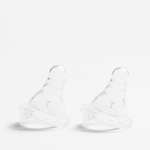
2x Transition Teat
Share
Airshield® Valve
Watch our Airshield® Valve in action | Releases air vacuum inside bottle, venting air back into the bottle and away from bubs tummy! Watch the bubbles!


Narrow Teat Flow Comparison
From 0-3 months, our NB, SS & T teats are designed to fill in the big jumps in flow rates left by more popular branded narrow neck teats. This allows babies to keep pace with their own-suck-swallow-breathe pattern instead of relying on compensation strategies like pacefeeding.
Please note: If switching from a softer "compression teat" like Dr Browns, there may be a small adjust period as your little one re-engages their sucking muscles - and check with a specialist for oral restrictions if they seem to be struggling.
Narrow Neck Vs Wide Neck Teats
Here is the genuine difference between narrow and wide neck teats using scientific and biologically-aligned insight in regards to which is best for optimal infant feeding

Passes Triangle Test
Our Natural Instinct Teats pass the infamous triangle test, confirming it's narrow shape supports a deep secure latch + stimulation of every baby's natural sucking reflex
Parents Also Love These


Natural Instinct Bottle (250ml)
$19.99
Unit price perNatural Instinct Bottle (250ml)
$19.99
Unit price per

Natural Instinct Bottle (120ml)
$14.99
Unit price perNatural Instinct Bottle (120ml)
$14.99
Unit price per


Formula Funnel
$9.99
Unit price perFormula Funnel
$9.99
Unit price per


Formula Dispenser
$9.99
Unit price perFormula Dispenser
$9.99
Unit price perFAQs
Our Airshield® Valve has been specifically engineered using what's called a one-way release duck-billed valve. This valve works by breaking/releasing the vacuum created inside the bottle as bub drinks. This release of pressure establishing regulated airflow inside the bottle, venting air back into the bottle and away from being ingested by bub. This system is evident through a continuous stream of bubbles whilst bub is drinking.
By swallowing less air as they are feeding, this helps burping post-feed which in essense minimises the underlying factor of trapped air in their tummy - which is what exasperates colic, wind discomfort and reflux.
The narrow shape of our teats also allows for a tight seal, so there are no air gaps between the silicone and bubs lips. This stops air getting in through the sides of the mouth (a notorious issue with wide neck teats).
For those with a bub aged 0 - 3 months, our 'NB' and 'SS' have slower flow rates than all other narrow neck teats suitable for that age bracket. Our slower flow rates of 4.98mls/min (NB) and 8.69mls/min (SS), allow bub to calmly regulate their suck-swallow-breathe pattern which is a instinctive reflex that minimises gulping or fast swallowing - which is other common factor which exasperates colic, wind & reflux issues.
This is a common question, and it stems from the "Breast is Best" messaging that has shaped parenting advice since wide-neck teats became popular. Here's what the science actually tells us.
The key difference between a breast and a wide-neck teat
A real breast nipple can extend deep into a baby's mouth, which does two important things:
- Creates a deep latch
- Stimulates lingual cupping - the natural tongue movement that triggers a baby's sucking reflex
A wide-neck silicone teat cannot replicate this. It also lacks an areola, which on a real breast acts as a signal between the skin, milk glands, and nipple to coordinate milk flow.
Without these mechanics, babies tend to compensate by feeding from their lips and lower jaw - a shallow latch that can cause feeding difficulties.
What about the wide splay of a breast?
Yes, a wide lip splay is important when breastfeeding - it helps a baby engage with the areola. But that's not what wide-neck teats are designed to replicate. The shape looks similar, but the function is entirely different.
What hospitals do
Maternity wards recognise this distinction. When newborns need feeding support while establishing breastfeeding, they are offered narrow neck teats - not wide ones.
Our approach
Lil'Kooee is built around supporting a baby's natural feeding instincts. Narrow neck teats more closely support the deep latch and sucking mechanics a baby is biologically designed to use - which is exactly why we chose them.
A baby will not be required to pace-feed when using Lil'Kooee's bottles & teats. Thanks to our meticuously calibrated flow rates and Airshield® Valve technology, your bub's feeding experience using our bottles will be slow enough for them to regulate the feed themselves.
Please note, if you are using a different branded bottle currently and are having to pace-feed, it is most likely due to the fact the flow rate is too fast. Furthermore, the bottle positioning required to pace-feed also alters the mechanics of the venting system as most require the teat to be fully filled with milk.
Our Natural Instinct Teat flow rates are as follows:
1. 'NB' (Newborn up to approx. 5kg)
2. 'SS' (1 - 3 Months)
3. 'S' (3 - 6 Months)
4. 'M' (6-12 Months)
5. 'X' (12+ Months)
Ages are only a guide. Some babies will stay on a flow for longer than the specified age or move up faster than expected. As a rule of thumb, a feed under 12 weeks should take 30-40 minutes, similar to breastfeeding. After 12 weeks a feed should start to pick up speed and take approx. 20 mins to complete. If they start to take longer or reduce volume, then it's time to try the next flow rate.
If your new to Lil'Kooee and not sure where to start, try our Teat Trial Packs.
Yes! We had these teats tested by Infant Feeding Labs USA, to ensure our flow rates were sitting in the genuine slow flow range. Teat flow rates are a unregulated factor to teat manufacturing, so bottle and/or teats claiming to be suitable for newborns can have a flow rate anywhere from 5ml to 45mls per minute.
For reference, our 'NB' teats are 4.98mls/minute and our 'SS' teats are 8.69 mls/minute.

Lil’Kooee is an Australian-owned brand creating innovative baby feeding products designed with expert-backed knowledge to simplify parenting and support every child’s feeding journey - created by the founder of Happy Baby Consultancy, a trusted name in baby sleep & feeding support.

© 2026,
Lil'Kooee.